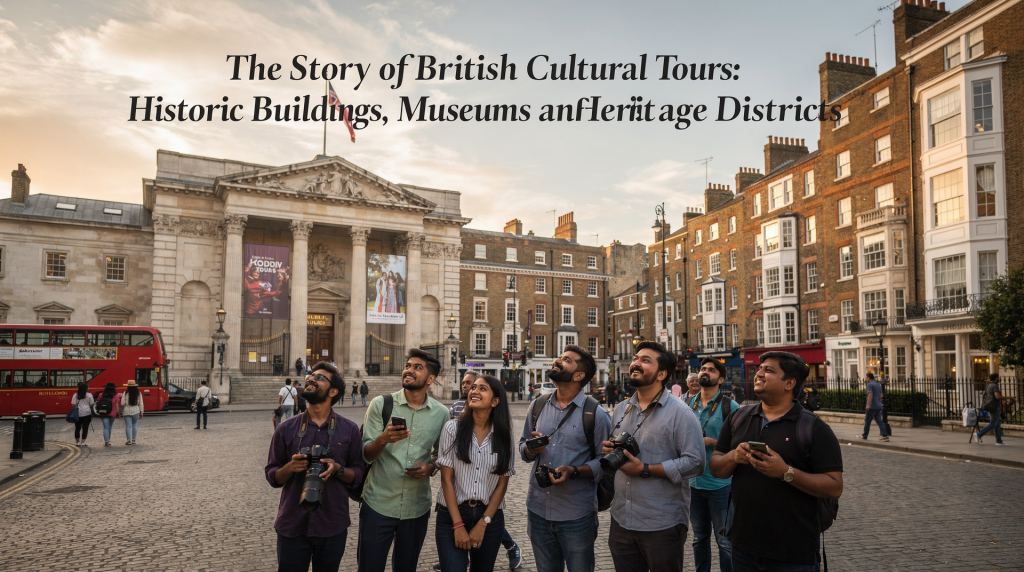
British cultural tours are rarely just about ticking landmarks off a list. Walk through any well-planned route and you quickly sense that the streets, houses, museums and entire quarters are being read to you — a layered narrative of power, trade, taste, religion, industry and the quiet rhythms of daily life. For a traveller from India, this is where the experience becomes magnetic: you are not only seeing Britain, you are learning how its cities were built, how heritage is protected, and why certain places still feel so completely alive. Beneath the white stucco and the stone dressings, there is always a lesson about what it means to live with history — a question that often stays with you long after the trip.
Why British cultural tours matter
A well-structured cultural tour in Britain almost inevitably weaves together three layers. The first is a historic building — a cathedral, manor house, palace or modest townhouse that anchors the visit. The second is a museum, archive or collection that fills in the wider story the architecture alone cannot tell. The third is the heritage district itself, where the urban fabric, street widths, paving materials and even the spacing of windows carry meaning. When these three layers work together, you gain something rare: both the object and its original setting. A building becomes far easier to read once you know who commissioned it, what it replaced, how the neighbourhood changed around it, and — just as importantly — how it is protected today. That last point is one I always emphasise on tours; private ownership inside a conservation area comes with obligations that few visitors suspect.
What counts as a cultural tour in Britain
Not every sightseeing walk qualifies as a cultural tour. The strongest ones are built around careful interpretation — the guide or the curated route helps you understand why a place matters, not just what it looks like from the pavement. In my years of leading walks through Georgian and Victorian quarters, I learned that a good tour doesn’t simply list architects and dates. It shows how the building was used, who serviced it, and what has been altered or reinstated during later restorations. These are the details that turn a façade into a document.
Common formats include:
- city walking tours through medieval, Georgian, Victorian, or industrial districts
- tours of historic houses open to the public (often owned by trusts or private families)
- museum-led experiences with architectural or social history themes
- themed routes tied to literature, royal history, design, or religion
- heritage walks through conserved quarters with listed buildings and protected streetscapes
In practical terms, a strong tour answers questions such as:
- Who lived here, and who worked here?
- What period does the building genuinely belong to — and what was added later?
- How has the use of the place changed, from private house to institution or apartments?
- What details are original, and which ones are careful reproduction or restoration?
- Why is this district protected today, and what constraints does that place on owners?
For anyone who has ever imagined owning a house with a stucco ceiling and a fanlight, that last question is far from academic. A Grade II listing or a conservation area designation means every window repair, every colour choice, and every internal alteration may need written consent. It is the hidden framework that keeps whole streets looking coherent — and, occasionally, drives owners to distraction.
The historic buildings that shape British cultural tours
Historic buildings are often the anchor of the experience, but they are not interchangeable. The most memorable ones fall into distinct types, each with its own architectural logic and its own set of preservation challenges.
Cathedral cities and religious architecture
A cathedral is frequently the starting point for understanding a city. It reveals how religious institutions shaped settlement patterns, trade, education and local power over centuries. Around the cathedral you usually find a compact quarter of older lanes, clergy houses, market squares and civic buildings — a piece of urban planning that still dictates property boundaries today. When I walk groups through such precincts, I always point out what is easy to miss: the medieval street pattern has often survived because the Church owned the land and resisted redevelopment, producing a street layout far less regular than the Georgian avenues elsewhere. Look for stonework phases and repairs that signal different building campaigns, stained glass, memorials and tombs, and the relationship between the church, the market and the municipal buildings. Owners of homes within these precincts live with an extra layer of ecclesiastical or historic oversight, and even modest terraces can carry Grade I or II* listing.
Stately homes and country houses
Country houses explain landownership, patronage and domestic life across centuries. They also show how taste evolved from medieval formality to Georgian symmetry and Victorian comfort. Many tours include formal interiors with original furniture, gardens and designed landscapes, servant spaces and back-of-house routes, and collections of portraits, books and decorative arts. From a conservation perspective, these houses often illustrate the compromise between public access and private occupation: some are still family homes where only a wing is open to visitors, while others have been turned over entirely to trusts. The difference matters because the funding model dictates how aggressively restoration is pursued. A privately owned country house may have weathered stone and a worn kitchen garden that speaks of real, ongoing use — a texture that disappears under heavy institutional restoration.
Townhouses and terraces
In historic cities, the most revealing buildings are often not the grandest. Georgian terraces, merchant houses and Victorian townhouses show how wealth, status and urban planning worked at street level. A typical Georgian terrace reveals a narrow, deep plan with a rear closet wing; from the front, you see the symmetrical façade, the fanlight, the wrought-iron boot scraper — all designed for appearance, not efficiency. Inside, original joinery, fireplaces and staircases are often the most protected elements. These buildings make heritage feel tangible. You can see how façades were composed for symmetry and status, how narrow plots were used efficiently, how later conversions subdivided interiors into flats, and how whole streets were preserved as ensembles rather than isolated monuments. For the prospective buyer from abroad, these are the houses that feel most attainable — and yet they come with the heaviest day-to-day constraints on materials, glazing and even internal partitions.
Industrial and civic heritage
Britain’s heritage tours also make room for mills, docks, warehouses, bridges, railway buildings and civic halls. These places tell a different story from castles and palaces: commercial ambition, labour and migration, engineering and infrastructure, and municipal pride and reform. They are often structurally robust but harder to adapt to modern residential use, and conversion projects in such buildings can become studies in compromise — inserting insulation behind solid brick walls, rerouting services without damaging cast-iron columns, keeping original fireproof doors while meeting current building regulations. When you walk through a former warehouse turned into apartments, notice what was retained and what was quietly sacrificed.
Why museums belong in the same story
Museums are not separate from heritage tours; they are frequently the key to making sense of them. A building may be beautiful, but a museum gives it context. Too often, I watched visitors rush from one highlight to the next, ignoring the curator’s attempt to explain the social history of the district. A well-placed museum does one or more of these: explains the social history of a district, displays objects from the same period as the surrounding architecture, preserves interiors that cannot survive everyday use, and connects local stories to national or global events. For example, a museum housed in a former town house may explain the household structure of its original residents down to the number of live-in servants. A city museum may show how transport, trade, or war reordered the very streets you have just walked.
How to read a museum on a heritage tour
Instead of rushing through galleries, use museums to answer three questions: What was this place before it became a museum? Which objects genuinely belong to the building’s original life? And what does the collection reveal that the architecture alone cannot? That approach makes museums feel less like a detour and more like part of the tour’s narrative. It also deepens your sense of what it took to maintain such a building over time — the inventories, the staffing, the lighting — all the invisible effort that someone still has to budget for if the building remains in private hands.
Heritage districts: where the city itself becomes the exhibit
Some of the most memorable British cultural tours take place in heritage districts rather than single buildings. These areas matter because preservation is not about one façade; it is about the whole streetscape — the rhythm of doorcases, the consistent cornice heights, the survival of historic shopfronts with their glazed tiles and signboards. Well-known heritage districts often have survived street patterns, consistent building heights, historic shopfronts, squares, courtyards, lanes, protected sightlines and public spaces, and a careful mix of uses that keeps the area active rather than embalmed. The key idea is that the district is historically significant as a whole, which is why these places feel coherent, walkable and visually rich. This coherence is usually backed by a conservation area designation and sometimes by an Article 4 Direction that removes permitted development rights — meaning that even replacing a front door or cleaning brickwork can require permission. For a resident, it preserves the street’s character; for a visitor, it means what you see is largely what was intended.
What makes a heritage district worth visiting
A strong heritage district usually offers a density of historic fabric, clear architectural periods visible side by side, public access through streets, squares and courtyards, ongoing neighbourhood use rather than preserved display, and interpretation through plaques, museums or guided routes. When you walk one of these districts, pay attention to the rear lanes and mews. They often reveal the services spaces — the stables, the coal stores, the modest dwellings — that supported the elegant fronts. That contrast is part of the story, and it is something a guide or a well-written trail can unlock.
A practical way to experience a British cultural tour
If you want the trip to feel insightful rather than rushed, a methodical approach helps. Over years of guiding, I settled on a three-part rhythm: preparation, slow walking, and a reflective debrief.
Before you go
- Read the basics of the place’s history — not just the date, but the economic and social forces behind it.
- Identify the main architectural period so you can spot later insertions.
- Check whether the building is open, ticketed, or viewable only from outside; some private houses open just a few days a year.
- See whether the district has heritage signage, a visitor trail, or a conservation area appraisial online.
- Allow time for one good museum and one long walk, not a series of huried stops.
On the day
- Start with the wider district before entering the building. Walk the perimeter and notice the street layout, building materials and rooflines.
- Look for signs of adaptation: new entrances, altered windows, repaired stonework with slightly different colour or tooling.
- Take a slower pass through one or two rooms instead of trying to see everything; notice door swings, floor levels, and original fireplaces.
- Compare the polished public story with the service areas, side streets and back lanes — this is where the household economy becomes visible.
After the visit
- Note what was original and what was restored. Was the wallpaper a reproduction? Were the floorboards replaced?
- Think about how the building functioned in daily life — heating, lighting, water supply.
- Ask what the place teaches about ownership, labour and social hierarchy.
- Save details that might matter for future visits: district name, nearby museums, opening patterns, and any estate agents’ boards that hint at what is for sale.
Typical mistakes visitors make
Many people leave heritage sites with photos but no real understanding. The most common mistakes I observed were:
- Treating every historic building as the same kind of attraction, without distinguishing a medieval hall from a Victorian terrace.
- Igoring the district and focusing only on the main monument.
- Visiting too many sites in one day, so each blurs into the next.
- Skipping museums that explain context, because they seem like a detour.
- Asuming restoration means everything you see is original — in practice, much may be careful reproduction.
- Overlooking modern use, which often keeps heritage buildings viable and reveals how building regulations and ownership shape what you see.
A better approach is to visit fewer places and read them more carefully. When you slow down, you begin to notice the things that dictate whether a historic house is genuinely comfortable to live in — ceiling heights, draughts, the physical depth of walls that makes servicing difficult — and that awareness is part of truly understanding heritage.
Comparing the main types of British cultural heritage experiences
| Type of visit | What you learn | Best for | Common mistake |
|---|---|---|---|
| Historic house tour | Domestic life, status, interiors | Architecture lovers, design fans | Focusing only on decoration |
| Museum visit | Context, objects, chronology | First-time visitors | Treating it as separate from the building |
| Cathedral or church tour | Religion, politics, craft, burial culture | History-focused travellers | Rushing through the nave and forgetting the precinct |
| Heritage district walk | Urban history, planning, street character | City explorers | Looking only at major landmarks |
| Industrial heritage route | Labour, engineering, transport, trade | Curious repeat visitors | Assuming “heritage” means only aristocratic sites |
How Indian travellers can get more from these tours
Indian visitors often bring a strong instinct for layered history, because many Indian cities combine sacred, colonial, commercial and domestic heritage in one urban fabric. That makes British cultural tours especially rewarding when approached as lived history, not as postcard tourism. Useful questions to ask on site include: How old is the structure, and what has changed over time? Who funded or commissioned it? Was it private, civic, religious, or industrial? How did the surrounding district evolve? Is the building still in use, and if so, how has it been adapted? This perspective helps you compare places across countries without flattening them into “old and beautiful.” It also quietly introduces the practical dimensions of stewardship: in both nations, private heritage ownership often means balancing cultural responsibility with everyday comfort.
A simple checklist for choosing a strong heritage tour
Use this checklist before booking:
- The tour explains historical context, not just surface facts.
- The route includes both buildings and the surrounding district.
- The guide or audio material identifies architectural periods clearly.
- There is time for museums, interiors, or archival interpretation.
- The itinerary avoids overloading the day with too many stops.
- The experience includes practical details on access, timing, and walking distance.
- The site is open about conservation, restoration, or restrictions — and the guide does not pretend that every original feature survives intact.
Why these tours still matter today
British cultural tours remain popular because they offer more than nostalgia. They show how heritage can stay useful: as education, as public space, as tourism, and — crucially — as a lived-in home or working building. They also teach a lesson for any traveller interested in historic places: preservation is most meaningful when buildings are understood as part of daily life, not as frozen objects. The same cornice that delights you on a tour is the one that will need repainting every few years if you ever find yourself owning a listed flat. That tension between beauty and obligation is, ultimately, what gives heritage its edge.
Conclusion
The best British cultural tours connect architecture, museums and heritage districts into one coherent story. They help you see how cities were built, how people lived, and why some places have been carefully preserved while others changed beyond recognition. For travellers who value history with substance, these tours are not just sightseeing; they are a way to read the city properly. And for anyone who has ever stood on a Georgian square and wondered what it would be like to own one of those doors, the tour becomes the first step in understanding what that commitment truly entails — the permissions, the materials, the obligations, and the quiet daily reality of living inside a piece of history.
FAQ
What is the difference between a heritage tour and a regular sightseeing tour?
A heritage tour explains historical meaning, architectural context and cultural significance, while a regular sightseeing tour may focus mainly on landmarks and photo stops. The heritage tour will usually touch on how a building is protected and what that protection means for owners and the public.
Are historic buildings in Britain usually open to the public?
Some are fully open, some are partially open, and others can only be viewed from outside. Opening times often vary by season and event; private houses that open under the Historic Houses association or similar schemes may restrict access to a few days per year.
Why are heritage districts important?
They preserve the relationship between buildings, streets and public space. This gives a fuller picture of how a city developed over time and, crucially, maintains the setting that makes individual buildings worth protecting.
Should I visit museums or buildings first?
If possible, start with a walk through the district and then visit the building or museum. That sequence makes the context easier to understand — you see the streetscape first, then step inside to add the domestic or institutional detail.
What makes a cultural tour feel authentic?
Clear historical interpretation, manageable pacing, real architectural detail, and a route that reflects how people actually lived and moved through the city. Authenticity also comes from a guide who is frank about restoration, reconstruction, and the compromises of modern ownership.